

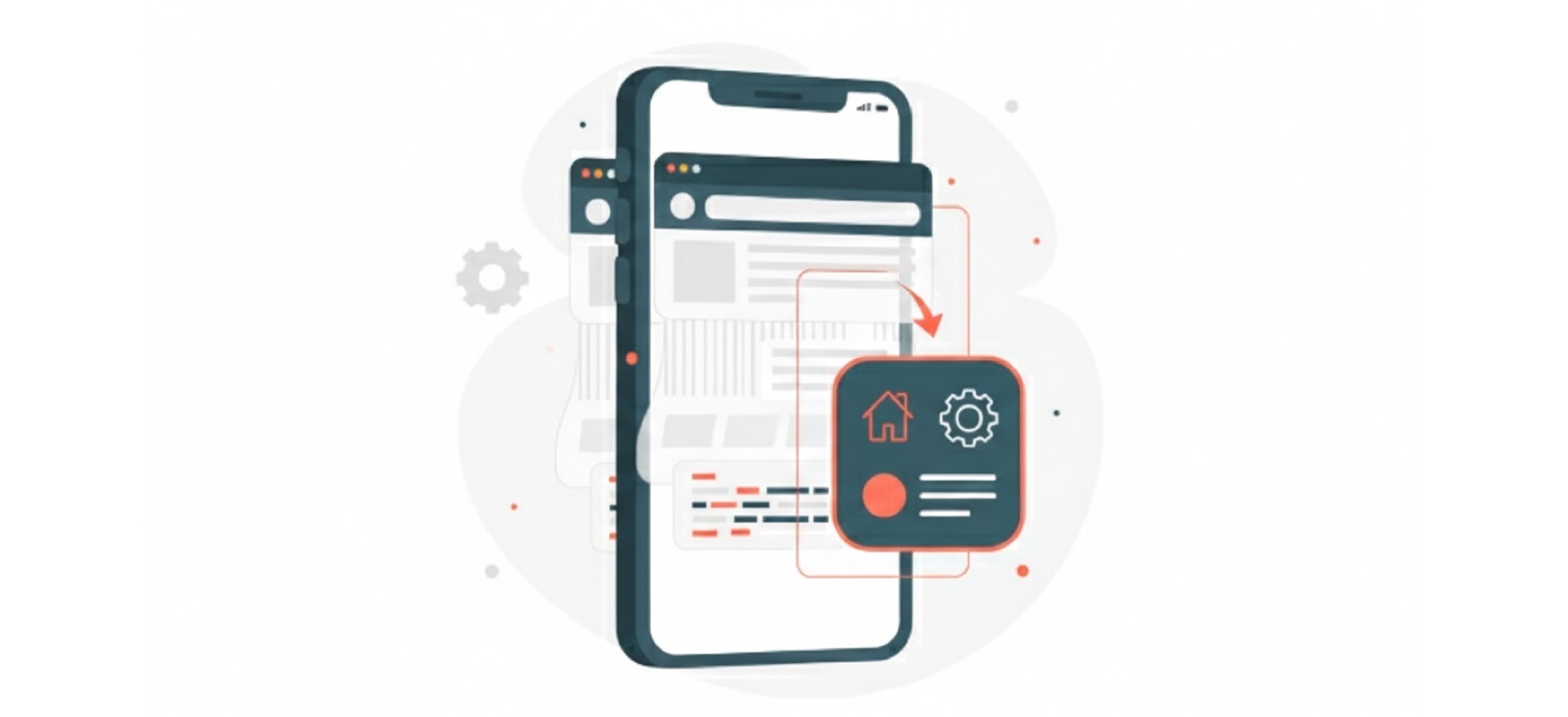
“We need an app” is one of the most frequent requests we receive. Often, however, the real question should be: “Do we need a mobile presence?” The difference is substantial. Because the best solution is not always to develop an app to publish on the App Store or Google Play. Many times, what’s really needed is a fast, accessible mobile service that is integrated into business processes.
The Revolution of Progressive Web Apps (PWA)
Progressive Web Apps (PWAs) are advanced websites that, once opened on a smartphone, behave like native apps: they can send push notifications, work offline, be added to the home screen, and access device hardware.
The advantage? Lowering the barrier to entry.
A native app is essential when intensive use of 3D graphics is required, when deep and continuous access to hardware is needed (advanced Bluetooth, specific sensors, NFC), or when having a strong presence in app stores is vital for the brand. In these cases, separate development for iOS and Android makes strategic sense.
For a B2B client or an occasional user, having to download 100MB from an app store is an obstacle.
In the B2B world, the dynamics are different. A PWA is often the winning choice for B2B portals, management dashboards, and internal corporate platforms.
The tangible benefits include: lower development costs, instant updates (no waiting for app store approvals), and search engine indexing. A PWA is instantly accessible via a link, always up to date, and significantly less expensive to maintain compared to two native apps (iOS and Android).
For most B2B companies, a well-designed PWA delivers 90% of the benefits of a native app at 50% of the maintenance costs, with zero installation friction.
The decision is not purely technological, it must be strategic: who is the user, how often will they use the service, how critical is it to reduce the barrier to entry, and is the goal user acquisition or operational efficiency? Starting from these questions completely changes the approach.